• Skip to main content
  • Skip to secondary menu
  • Skip to footer

Analysis.org

Intelligence Analysis in Market Context

  • Sponsored Post
  • Market Research Reports
    • Technology Analysis
  • About
  • Contact

Nvidia, Broadcom, and AMD: Mapping the Next Blue Oceans in the AI Super-Cycle

October 6, 2025 By Analysis.org

The AI super-cycle has thrust semiconductors into the center of global strategy, turning companies like Nvidia, Broadcom, and AMD into household names. All three compete in overlapping arenas—GPUs, accelerators, networking, and custom silicon—but their paths forward don’t need to be confined to a zero-sum “red ocean” fight. Applying the Blue Ocean Strategy lens, we can see how each player has already sidestepped brutal head-to-head competition and where their next uncontested waters may lie.
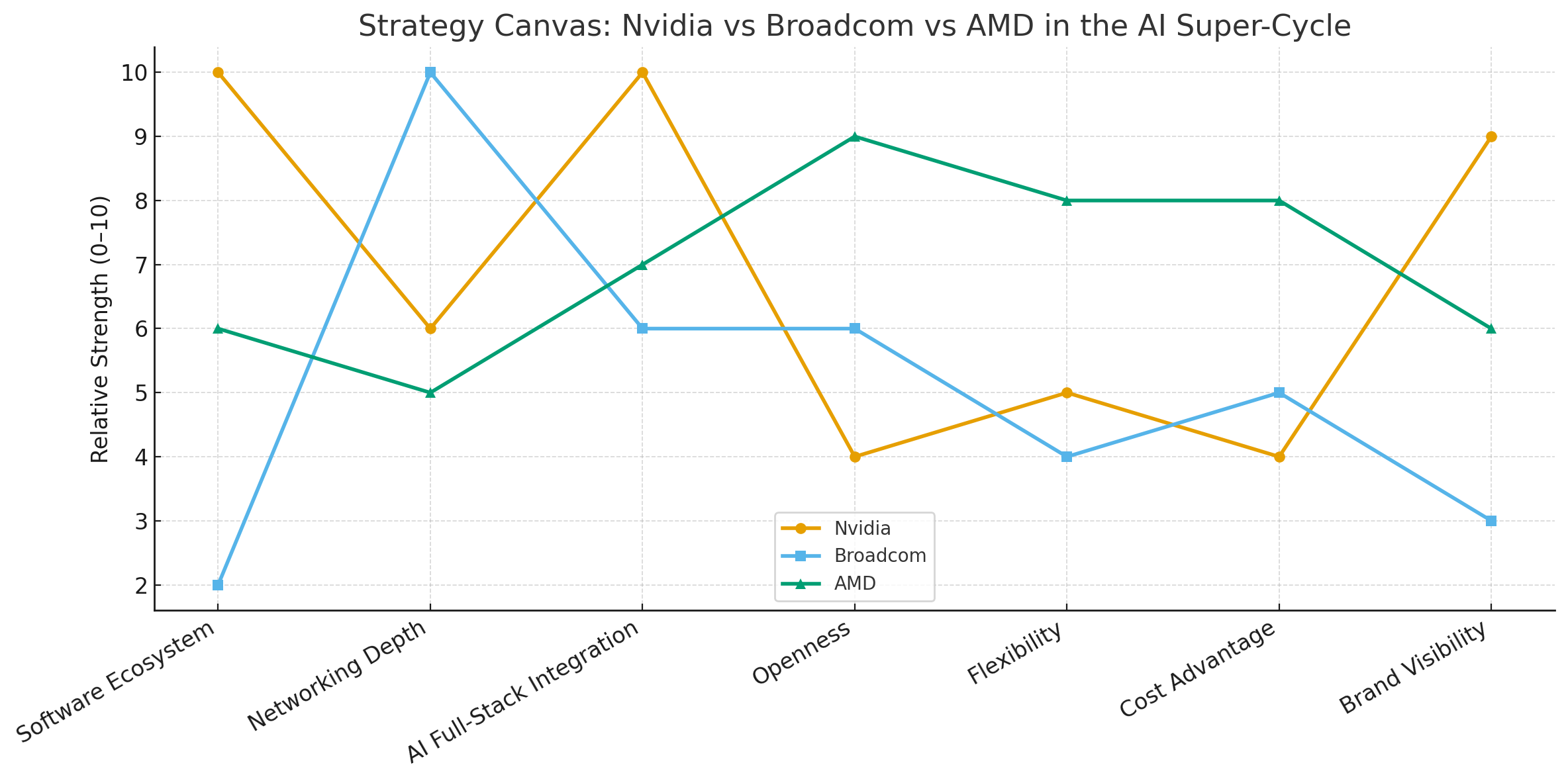
Strategy Canvas: Nvidia vs Broadcom vs AMD in the AI Super-Cycle
Here’s the strategy canvas comparing Nvidia, Broadcom, and AMD.

It shows how their strengths diverge: Nvidia dominates on software ecosystem and full-stack integration, Broadcom owns networking depth but has weak brand visibility, and AMD positions itself as the flexible, open, cost-friendly challenger. Each curve reflects a different blue ocean they’ve carved within the AI market.

Nvidia: Expanding Beyond Chips Into the AI Operating System

Nvidia’s genius blue ocean move was not just building faster GPUs, but creating CUDA and the software ecosystem that made them indispensable to developers. In the “red ocean” of pure silicon speed, AMD and Intel could theoretically compete. But in the “blue ocean” of being the operating system of AI, Nvidia became irreplaceable.

Eliminate: Dependency on CPU-centric compute; commoditized driver layers.

Reduce: Traditional chip design cycles—Nvidia accelerated iteration.

Raise: Investment in developer ecosystems, frameworks, and AI-optimized libraries.

Create: A full-stack AI platform (CUDA, cuDNN, TensorRT, DGX systems, Omniverse, NIM microservices).

Looking ahead, Nvidia’s next blue ocean is in agentic AI infrastructure. It is positioning itself not just as a chipmaker but as the backbone of AI agents—providing inference-optimized GPUs, networked AI factories, and cloud-native inference APIs. A second blue ocean is in sovereign AI stacks: offering countries turnkey AI platforms that bypass hyperscaler dependence. The risk is regulatory scrutiny and over-concentration, but Nvidia’s culture of building software moats around hardware remains its sharpest edge.

Broadcom: The Quiet Architect of AI Networks

Broadcom rarely gets the headlines Nvidia does, but its blue ocean play has been just as clever: rather than compete directly in GPUs, it owns the plumbing of the AI data center. Every hyperscaler building AI clusters runs on Broadcom’s networking chips, interconnects, and custom ASICs.

Eliminate: The need for hyperscalers to buy networking from many small vendors.

Reduce: Reliance on general-purpose CPUs for data movement.

Raise: Bandwidth, efficiency, and reliability of interconnects.

Create: A quasi-monopoly in AI networking (switches, SerDes, PCIe, optical).

Broadcom’s future blue oceans may emerge in AI-optimized networking fabrics (making interconnects as critical as GPUs in system design), quantum-era networking layers (where secure, ultra-low latency links become essential), and custom ASICs for hyperscalers (where it acts as the invisible foundry for Google, AWS, Meta). Its challenge is visibility—Broadcom isn’t a consumer brand—but its strength is the opposite of Nvidia’s: it thrives in being irreplaceable infrastructure few outsiders even think about.

AMD: The Challenger Seeking Its Own Blue Ocean

AMD has long played catch-up, but its survival has always depended on finding side doors. It undercut Intel in CPUs, then leveraged open standards like ROCm to position against Nvidia. Its MI300 accelerators show AMD is serious about AI—but if it simply mirrors Nvidia, it risks drowning in the red ocean of GPU wars.

Eliminate: Proprietary lock-in wherever possible; AMD leans on open ecosystems.

Reduce: Pricing complexity (offering hyperscalers more attractive economics).

Raise: Flexibility—AMD chips are often more customizable.

Create: A credible second source for AI accelerators, which regulators and hyperscalers need to keep Nvidia in check.

AMD’s prospective blue oceans lie in hybrid architectures (combining CPU, GPU, and memory coherently), edge AI accelerators (smaller, power-efficient GPUs for inference outside data centers), and custom co-design with hyperscalers (mirroring its semi-custom success with PlayStation/Xbox). If AMD doubles down on being the “open, flexible alternative” in AI hardware, it could cultivate a distinct demand curve—especially if governments and cloud providers grow nervous about Nvidia’s dominance.

Strategy Canvas: Diverging Curves in the AI Market

Nvidia plots high on software ecosystem, AI full-stack integration, and premium pricing, but lower on openness.

Broadcom scores highest on networking depth, low visibility in consumer mindshare, and is nearly absent in developer ecosystems.

AMD emphasizes cost flexibility, open standards, and co-design potential, but lags Nvidia on ecosystem lock-in.

Each diverges sharply from the “red ocean” of generic silicon vendors. Nvidia created an AI OS, Broadcom a networking backbone, AMD a flexible challenger role.

Future Blue Oceans: Probability-Weighted Outlook

Nvidia as AI OS & Agent Infrastructure (65% likely): Nvidia extends CUDA into a global inference platform, bundling software + silicon.

Broadcom as AI Networking Monopolist (55% likely): AI data centers become bottlenecked by interconnects, and Broadcom owns the rails.

AMD as Open, Flexible Alternative (40% likely): Wins share via semi-custom, edge AI, and open ecosystems.

All three squeezed by sovereign demands & new entrants (25% likely): Governments or open-hardware coalitions disrupt the current order.

What’s striking is how different their blue oceans are: Nvidia sells an AI future, Broadcom sells the rails, and AMD sells choice. Together, they don’t just compete—they define the terrain of the AI era. The next five years will decide whether their oceans remain blue, or slowly turn red as hyperscalers, governments, and startups look for ways to break their dominance.

Filed Under: Briefing

Footer

Recent Posts

  • Apple Delivers a Power Quarter as Growth Reaccelerates Across the Board
  • PayPal’s Reset Moment Feels Less Like a Shuffle and More Like a Bet on Focus
  • Reading the PEG Ratio Across Nvidia, Broadcom, and AMD
  • Nvidia’s $5 Trillion Is Earned, Not Borrowed
  • Taiwan Overtakes UK as World’s 7th-Largest Stock Market
  • Intel Q1 2026: Recovery Signals Strengthen, but the Turnaround Is Still Unfinished
  • Yuan Gains Ground, But the Dollar Still Dominates
  • MongoDB Expands Irish Operations with €74 Million Investment in AI and Engineering Growth
  • ServiceNow Q1 2026: The AI Control Tower Thesis Is Holding
  • Adobe’s $25 Billion Buyback Is a Bet on Itself

Media Partners

  • Market Analysis
  • k4i.com
  • Market Research Media
The Bill Comes Due
The Software-Defined Camera Won. The Open OS Did Not.
Cars Are Computers Now, and Most Carmakers Aren’t
Gartner: Global IT Spending to Hit $6.31 Trillion in 2026, Driven by AI Infrastructure
The SDK Generator Benchmarks: Infrastructure vs. Convenience
Infographic: We Are Likely in the Early Stages of Another Productivity Boom
Infographic: Establishing the National Multimodal Freight Network
Global WiFi Market: Size, Segmentation, Trends, and Forecast to 2030
Synera’s $40M Series B: What the Press Release Isn’t Saying
Amazon’s Globalstar Acquisition Is a Spectrum War Dressed as a Satellite Deal
Mistral Is Building the U.S. Gateway for Israeli Autonomous Weapons
Andon Market: The AI Agent Retail Experiment
ASML Accelerates EUV Production Amid AI Chip Demand
Cyera Acquires Ryft for $100M–$130M
Genki Robotics Reaches $1 Billion Valuation
Google's AI Compute Duopoly
GPT-5.4 Solves the Erdős Problem
Palantir's Civil Liberties Crisis
SS7 and Diameter Vulnerabilities Enable State Surveillance
815 Security Violations, 1,032 Open Vulnerabilities: Inside DCSA's FY2025 Compliance Data
China’s U.S. Treasury Holdings: The Great Repositioning (2021–2025)
Infographic: Why the 2025 CIPA Data Proves the APS-C Renaissance is Real
How WiFi Changed Media
Canva Acquires Simtheory and Ortto to Build End-to-End Work Platform
Netflix Price Hikes, The Economics of Dominance in a Saturated Streaming Market
America’s Brands Keep Winning Even as America Itself Slips
Kioxia’s Storage Gambit: Flash Steps Into the AI Memory Hierarchy
Mamdani Strangling New York
The Rise of Faceless Creators: Picsart Launches Persona and Storyline for AI Character-Driven Content
Apple TV Arrives on The Roku Channel, Expanding the Streaming Platform Wars

Media Partners

  • 3V.org
  • Referently.com
  • Media Presser
Ozempic Pill Arrives in the U.S., A Familiar Diabetes Drug Takes a New Form
Adobe Summit Investor Session, April 21, 2026, Las Vegas
Tempus AI Introduces Active Follow-Up Model to Keep Oncology Care Aligned with Rapidly Evolving Guidelines
Birch Coffee Keeps Growing in NYC with Square Powering the Back End
What Actually Holds Europe Together
Retention Over Turnover: Clasp’s $20M Bet on Fixing Healthcare Hiring
Doctronic Secures $40 Million Series B as Autonomous AI Medicine Moves Into Real Clinical Practice
Halter Lands $220 Million to Scale Virtual Fencing Worldwide
How Phone Cameras Changed Everyday Memory
Perfect Corp. Brings AI Shopping Agents to the Frontline of Retail at Shoptalk 2026
Sponsored Post
About
Contact
Photo of the Day: Burano Canal in Winter Light
What Is Travel Tech?
60 GHz WiGig Is Not Dead: Here Is Where It Actually Makes Sense
802.11r, 802.11k, 802.11v: The Three Protocols That Make WiFi Roaming Seamless
HaLow (802.11ah): The Sub-1 GHz WiFi Standard Built for IoT That Nobody Talks About
How Enterprise WiFi Authentication Actually Works: 802.1X and RADIUS Explained
How to Read Your WiFi Signal Strength: What dBm Numbers Actually Mean
China Has Shed $357 Billion in U.S. Treasuries Since 2021
Foreign Debt Holdings Are a Trade Deficit Problem, Not Just a Fiscal One
Foreign Holdings of U.S. Federal Debt Reached $9.2 Trillion in 2025
Japan Holds $1.185 Trillion in U.S. Debt and the Number Tells an Incomplete Story
NAB 2026: Las Vegas and the End of the Broadcast Era
Private Investors Now Dominate Foreign Holdings of U.S. Treasury Debt
The United States Paid $282 Billion in Interest to Foreign Debt Holders in 2025
Why Belgium Holds More U.S. Debt Than Saudi Arabia, and What That Actually Means
Biometric Technologies and Congress: Recent Legislation and Open Questions
Biometric Technologies and Global Security: An Overview

Copyright © 2026 Analysis.org

Media Partners: Technologies · Market Analysis · Market Research · Exclusive Domains · Photography

We use cookies on our website to give you the most relevant experience by remembering your preferences and repeat visits. By clicking “Accept”, you consent to the use of ALL the cookies.
Do not sell my personal information.
Cookie SettingsAccept
Manage consent

Privacy Overview

This website uses cookies to improve your experience while you navigate through the website. Out of these, the cookies that are categorized as necessary are stored on your browser as they are essential for the working of basic functionalities of the website. We also use third-party cookies that help us analyze and understand how you use this website. These cookies will be stored in your browser only with your consent. You also have the option to opt-out of these cookies. But opting out of some of these cookies may affect your browsing experience.
Necessary
Always Enabled
Necessary cookies are absolutely essential for the website to function properly. These cookies ensure basic functionalities and security features of the website, anonymously.
CookieDurationDescription
cookielawinfo-checkbox-analytics11 monthsThis cookie is set by GDPR Cookie Consent plugin. The cookie is used to store the user consent for the cookies in the category "Analytics".
cookielawinfo-checkbox-functional11 monthsThe cookie is set by GDPR cookie consent to record the user consent for the cookies in the category "Functional".
cookielawinfo-checkbox-necessary11 monthsThis cookie is set by GDPR Cookie Consent plugin. The cookies is used to store the user consent for the cookies in the category "Necessary".
cookielawinfo-checkbox-others11 monthsThis cookie is set by GDPR Cookie Consent plugin. The cookie is used to store the user consent for the cookies in the category "Other.
cookielawinfo-checkbox-performance11 monthsThis cookie is set by GDPR Cookie Consent plugin. The cookie is used to store the user consent for the cookies in the category "Performance".
viewed_cookie_policy11 monthsThe cookie is set by the GDPR Cookie Consent plugin and is used to store whether or not user has consented to the use of cookies. It does not store any personal data.
Functional
Functional cookies help to perform certain functionalities like sharing the content of the website on social media platforms, collect feedbacks, and other third-party features.
Performance
Performance cookies are used to understand and analyze the key performance indexes of the website which helps in delivering a better user experience for the visitors.
Analytics
Analytical cookies are used to understand how visitors interact with the website. These cookies help provide information on metrics the number of visitors, bounce rate, traffic source, etc.
Advertisement
Advertisement cookies are used to provide visitors with relevant ads and marketing campaigns. These cookies track visitors across websites and collect information to provide customized ads.
Others
Other uncategorized cookies are those that are being analyzed and have not been classified into a category as yet.
SAVE & ACCEPT