• Skip to main content
  • Skip to secondary menu
  • Skip to footer

Analysis.org

Intelligence Analysis in Market Context

  • Sponsored Post
  • Market Research Reports
    • Technology Analysis
  • About
  • Contact

Excess Ships, Thinner Margins: Maersk’s Loss Warning and What It Signals for MSC and Global Shipping

February 6, 2026 By Analysis.org

A quiet but telling shift is underway in global container shipping, and it’s no longer hiding behind record volumes or geopolitical noise. Maersk, long treated as the industry’s bellwether, has warned it could post its first operating loss in roughly a decade, a statement that lands less like a company-specific stumble and more like a structural confession. After years of pandemic-era distortions, emergency reroutings, and windfall pricing power, the industry is being dragged back into a classic shipping problem: too many ships chasing too little cargo. The irony is sharp. The same fleet expansion decisions that made sense when ports were jammed and rates were absurdly high are now flooding the market just as trade growth slows to a crawl. Even modest demand growth, the kind that would normally be celebrated, is no longer enough to absorb the capacity that has come online.
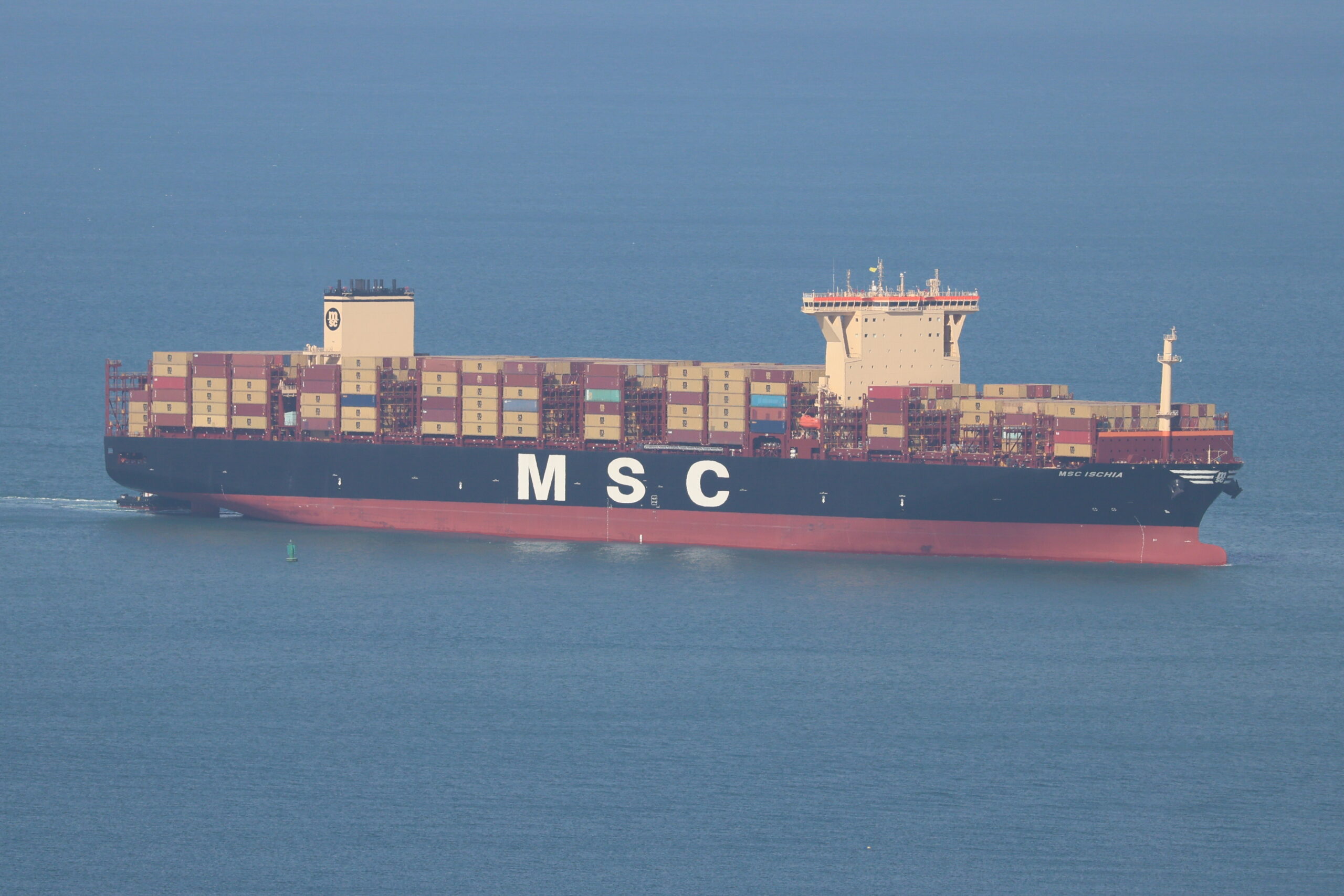
Container shipping
Photo credits: Pho.tography.org

Maersk’s warning is closely tied to two forces colliding at once. First, the delivery of new ultra-large container vessels ordered during the boom years has accelerated, swelling global capacity well ahead of demand. Second, the gradual normalization of Red Sea and Suez Canal routes has shortened voyages that were previously forced around Africa, effectively releasing even more capacity back into the system. Shorter routes mean faster turnaround, which in shipping terms is almost the same as adding ships without building them. Freight rates, predictably, have come under pressure. For Maersk, whose container business is no longer insulated by pandemic-era pricing, this combination threatens to tip its core shipping division into the red, even as its logistics and port operations remain profitable enough to soften the blow.

What makes this moment especially revealing is how it reframes the position of Mediterranean Shipping Company. MSC, the world’s largest container carrier, has not issued a public loss warning, partly because it is privately held and partly because its communication style is fundamentally different. But structurally, it is standing in the same weather system. MSC has expanded aggressively, locking in fleet dominance and market share at precisely the moment when the industry’s excesses are becoming unavoidable. That scale gives MSC flexibility, bargaining power, and optionality on routes, yet it also ties the company directly to the capacity glut weighing on global rates. When freight prices fall, size doesn’t make you immune; it just determines how much pain you can absorb before it shows.

There is a temptation to read Maersk’s warning as a one-off, or as evidence that integrated logistics strategies somehow failed to protect margins. That misses the point. What’s happening now looks less like mismanagement and more like the return of gravity. Container shipping has always been cyclical, but the pandemic delayed and distorted that cycle to an unusual degree. Governments intervened, supply chains froze, carriers printed cash, and everyone ordered ships. Now the bills are arriving at once. MSC’s lack of a formal warning doesn’t contradict Maersk’s outlook; it quietly confirms it. In a market defined by oversupply, discipline matters more than dominance, and even the biggest players are forced into price competition they’d rather avoid.

The broader signal here extends beyond individual companies. When Maersk talks openly about losses, it’s effectively saying that global trade volumes, while not collapsing, are no longer strong enough to mask structural overcapacity. That matters for exporters, ports, shipbuilders, and policymakers who still treat container shipping as a proxy for economic momentum. The ships are there, the lanes are open, and the goods are moving, but the economics have turned unforgiving again. This isn’t a crisis in the dramatic sense, but it is a reset, and resets in shipping tend to be long, dull, and painful rather than sudden and explosive.

For Maersk, the coming years look like a test of whether diversification into logistics can genuinely stabilize earnings through a downcycle. For MSC, the challenge is subtler: managing sheer scale without letting it amplify losses when rates fall. For the industry as a whole, the message is blunt. The era of easy money in container shipping is over, and the next phase will be defined not by how many ships you own, but by how carefully you decide to use them.

Filed Under: Briefing

Footer

Recent Posts

  • Excess Ships, Thinner Margins: Maersk’s Loss Warning and What It Signals for MSC and Global Shipping
  • Why AMD Shares Dropped 8% in Pre-Market Trading
  • Why Visa and Mastercard Jumped ~3% in a Single Session
  • Cloudflare’s 13% Jump Was About Virality, Timing, and a Perfect AI Fit
  • When AI Growth Starts Eating the Margins: Why Broadcom’s Warning Matters More Than the Stock Drop
  • Intel Q4 2025: Stabilization Without Momentum, AI Narrative Doing the Heavy Lifting
  • PR Bubbles and Forgotten Deals: Why Greenland Will Join Trump’s Archive of Vanishing Announcements
  • Nvidia’s $150 Million Bet on Baseten Is About Control, Not Just Compute
  • Maersk Downgraded, Shares Slide — and the Market’s Discomfort With Normality
  • Why Beam Therapeutics Inc. Jumped 27%: A Market Reading Beyond the Headline

Media Partners

Nameable
3v
Sharp Knife
Studio Tel Aviv
Abbreviatory
Exclusive
Side Hustle Art
Digital Market
Analysis
Posters

Media Partners

Analysis
API Course
DN4B
Defense Market
Publishing House
Passerby
Opinion
MKTG Dev
Media Gallery
Photo Contest

Copyright © 2017 Analysis.org

Technologies, Market Analysis & Market Research Reports, Photography

We use cookies on our website to give you the most relevant experience by remembering your preferences and repeat visits. By clicking “Accept”, you consent to the use of ALL the cookies.
Do not sell my personal information.
Cookie SettingsAccept
Manage consent

Privacy Overview

This website uses cookies to improve your experience while you navigate through the website. Out of these, the cookies that are categorized as necessary are stored on your browser as they are essential for the working of basic functionalities of the website. We also use third-party cookies that help us analyze and understand how you use this website. These cookies will be stored in your browser only with your consent. You also have the option to opt-out of these cookies. But opting out of some of these cookies may affect your browsing experience.
Necessary
Always Enabled
Necessary cookies are absolutely essential for the website to function properly. These cookies ensure basic functionalities and security features of the website, anonymously.
CookieDurationDescription
cookielawinfo-checkbox-analytics11 monthsThis cookie is set by GDPR Cookie Consent plugin. The cookie is used to store the user consent for the cookies in the category "Analytics".
cookielawinfo-checkbox-functional11 monthsThe cookie is set by GDPR cookie consent to record the user consent for the cookies in the category "Functional".
cookielawinfo-checkbox-necessary11 monthsThis cookie is set by GDPR Cookie Consent plugin. The cookies is used to store the user consent for the cookies in the category "Necessary".
cookielawinfo-checkbox-others11 monthsThis cookie is set by GDPR Cookie Consent plugin. The cookie is used to store the user consent for the cookies in the category "Other.
cookielawinfo-checkbox-performance11 monthsThis cookie is set by GDPR Cookie Consent plugin. The cookie is used to store the user consent for the cookies in the category "Performance".
viewed_cookie_policy11 monthsThe cookie is set by the GDPR Cookie Consent plugin and is used to store whether or not user has consented to the use of cookies. It does not store any personal data.
Functional
Functional cookies help to perform certain functionalities like sharing the content of the website on social media platforms, collect feedbacks, and other third-party features.
Performance
Performance cookies are used to understand and analyze the key performance indexes of the website which helps in delivering a better user experience for the visitors.
Analytics
Analytical cookies are used to understand how visitors interact with the website. These cookies help provide information on metrics the number of visitors, bounce rate, traffic source, etc.
Advertisement
Advertisement cookies are used to provide visitors with relevant ads and marketing campaigns. These cookies track visitors across websites and collect information to provide customized ads.
Others
Other uncategorized cookies are those that are being analyzed and have not been classified into a category as yet.
SAVE & ACCEPT