• Skip to main content
  • Skip to secondary menu
  • Skip to footer

Analysis.org

Intelligence Analysis in Market Context

  • Sponsored Post
  • Market Research Reports
    • Technology Analysis
  • About
  • Contact

Deflationary spiral: similarities between China’s current economic situation and Japan’s in the early 1990s

September 7, 2023 By Analysis.org

There are some similarities between China’s current economic situation and Japan’s in the early 1990s, which led to a decades-long deflationary spiral. These similarities include:

  • A property bubble that has burst, leading to falling prices and a large amount of bad debt.
  • A slowing economy, with weak investment and consumption.
  • An aging population, which is putting a strain on government finances.
  • A high level of debt, both in the private and public sectors.

However, there are also some important differences between the two countries. China’s economy is still much larger than Japan’s, and it has a more flexible labor market. This means that China may be able to avoid a prolonged deflationary spiral.

The Chinese government is aware of the risks of deflation, and it has taken some steps to try to prevent it. These steps include cutting interest rates, injecting liquidity into the economy, and stimulating investment. However, it remains to be seen whether these measures will be enough to prevent deflation.

If China does enter a deflationary spiral, it could have a number of negative consequences. Deflation can lead to a vicious cycle of falling prices, lower demand, and further declines in prices. This can make it difficult for businesses to invest and create jobs, and it can also lead to social unrest.

The Chinese government is taking steps to avoid a deflationary spiral, but it is a difficult challenge. If the government is not successful, it could have a major impact on the Chinese economy and the global economy.

Here are some of the things that China can do to avoid a deflationary spiral:

  • Continue to cut interest rates and inject liquidity into the economy.
  • Stimulate investment in infrastructure and other productive sectors.
  • Reform the financial system to reduce the level of debt.
  • Promote structural reforms to boost productivity growth.
  • Make the labor market more flexible.
  • Provide social safety nets to protect the most vulnerable.

It is too early to say whether China will be able to avoid a deflationary spiral. However, the government is aware of the risks and is taking steps to address them. The success of these measures will depend on a number of factors, including the severity of the economic slowdown, the effectiveness of the government’s policies, and the willingness of businesses and consumers to invest and spend.

It would be helpful to show two diagrams to illustrate the point. One diagram could show the GDP growth in Japan from 1990 to 2001, the period of the Lost Decade.
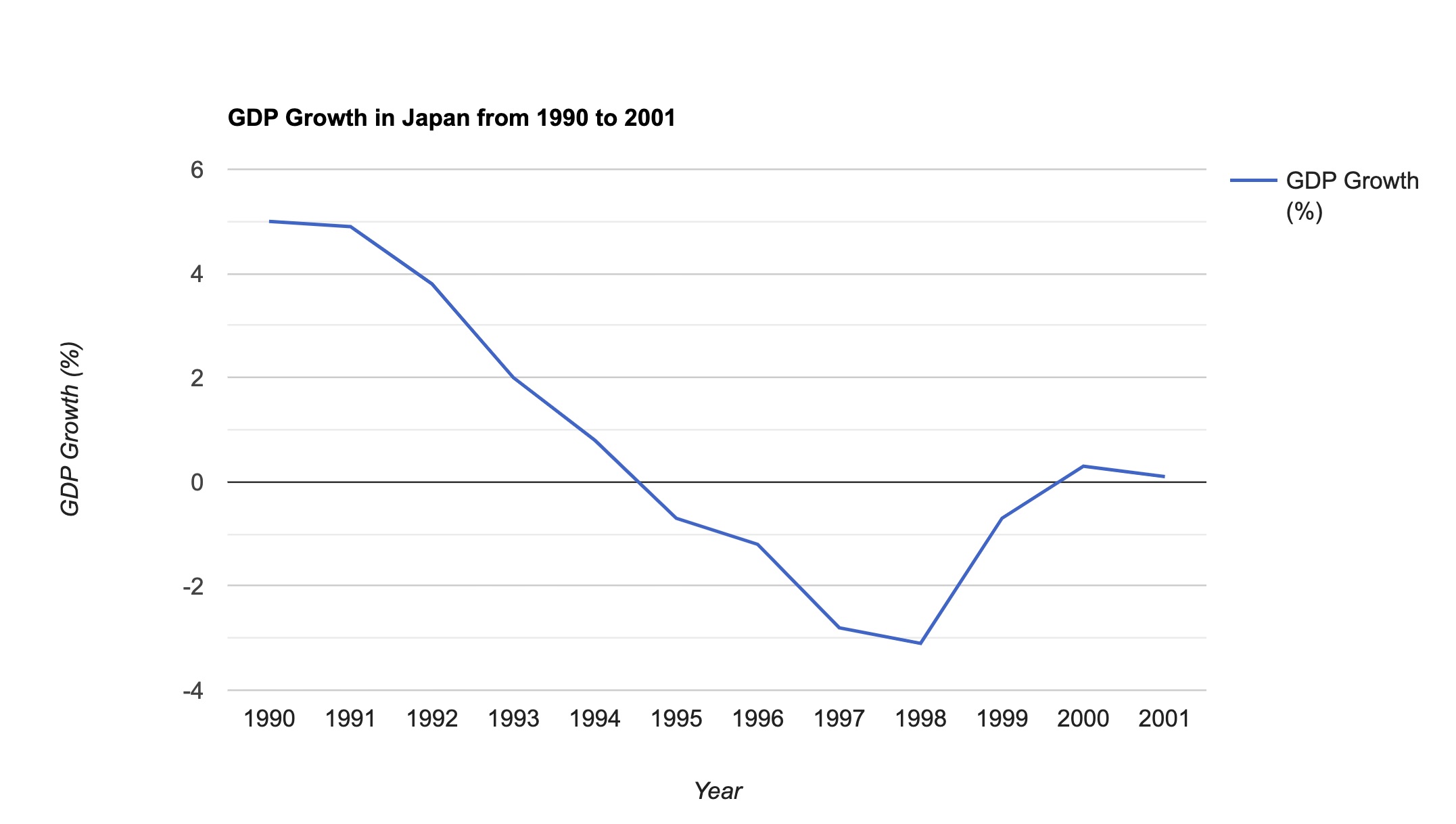
GDP growth in Japan from 1990 to 2001

The other diagram could show the GDP growth in China from 2022 to 2030, a projected period of economic slowdown.

The first diagram would show a clear decline in GDP growth in Japan from 1990 to 2001. This decline was caused by a number of factors, including the bursting of the Japanese asset bubble, the collapse of the Japanese banking system, and the global economic slowdown of the early 1990s.

The second diagram would show a slower rate of GDP growth in China from 2022 to 2030. This slowdown is expected to be caused by a number of factors, including the aging of the Chinese population, the slowdown of global economic growth, and the increasing debt burden of the Chinese government.


The two diagrams would illustrate the similarities between the economic situations of Japan in the 1990s and China today. Both countries are experiencing a slowdown in economic growth, and both countries are facing a number of challenges, including aging populations, debt burdens, and global economic slowdowns.

However, there are also some important differences between the two countries. Japan’s economy is much smaller than China’s, and China has a more flexible labor market. This means that China may be able to avoid a prolonged economic slowdown.

The future of the Chinese economy is uncertain. However, the two diagrams show that there are some similarities between the economic situations of Japan in the 1990s and China today. These similarities suggest that China may need to take steps to avoid a prolonged economic slowdown.

Filed Under: Briefing

Footer

Recent Posts

  • Apple Delivers a Power Quarter as Growth Reaccelerates Across the Board
  • PayPal’s Reset Moment Feels Less Like a Shuffle and More Like a Bet on Focus
  • Reading the PEG Ratio Across Nvidia, Broadcom, and AMD
  • Nvidia’s $5 Trillion Is Earned, Not Borrowed
  • Taiwan Overtakes UK as World’s 7th-Largest Stock Market
  • Intel Q1 2026: Recovery Signals Strengthen, but the Turnaround Is Still Unfinished
  • Yuan Gains Ground, But the Dollar Still Dominates
  • MongoDB Expands Irish Operations with €74 Million Investment in AI and Engineering Growth
  • ServiceNow Q1 2026: The AI Control Tower Thesis Is Holding
  • Adobe’s $25 Billion Buyback Is a Bet on Itself

Media Partners

  • Market Analysis
  • k4i.com
  • Market Research Media
The Bill Comes Due
The Software-Defined Camera Won. The Open OS Did Not.
Cars Are Computers Now, and Most Carmakers Aren’t
Gartner: Global IT Spending to Hit $6.31 Trillion in 2026, Driven by AI Infrastructure
The SDK Generator Benchmarks: Infrastructure vs. Convenience
Infographic: We Are Likely in the Early Stages of Another Productivity Boom
Infographic: Establishing the National Multimodal Freight Network
Global WiFi Market: Size, Segmentation, Trends, and Forecast to 2030
Synera’s $40M Series B: What the Press Release Isn’t Saying
Amazon’s Globalstar Acquisition Is a Spectrum War Dressed as a Satellite Deal
Mistral Is Building the U.S. Gateway for Israeli Autonomous Weapons
Andon Market: The AI Agent Retail Experiment
ASML Accelerates EUV Production Amid AI Chip Demand
Cyera Acquires Ryft for $100M–$130M
Genki Robotics Reaches $1 Billion Valuation
Google's AI Compute Duopoly
GPT-5.4 Solves the Erdős Problem
Palantir's Civil Liberties Crisis
SS7 and Diameter Vulnerabilities Enable State Surveillance
815 Security Violations, 1,032 Open Vulnerabilities: Inside DCSA's FY2025 Compliance Data
China’s U.S. Treasury Holdings: The Great Repositioning (2021–2025)
Infographic: Why the 2025 CIPA Data Proves the APS-C Renaissance is Real
How WiFi Changed Media
Canva Acquires Simtheory and Ortto to Build End-to-End Work Platform
Netflix Price Hikes, The Economics of Dominance in a Saturated Streaming Market
America’s Brands Keep Winning Even as America Itself Slips
Kioxia’s Storage Gambit: Flash Steps Into the AI Memory Hierarchy
Mamdani Strangling New York
The Rise of Faceless Creators: Picsart Launches Persona and Storyline for AI Character-Driven Content
Apple TV Arrives on The Roku Channel, Expanding the Streaming Platform Wars

Media Partners

  • 3V.org
  • Referently.com
  • Media Presser
Berkshire Hathaway's Annual Meeting Without Warren Buffett
Canelo vs. Benavidez: The Fight Boxing Spent Years Avoiding
Elon Musk's Nvidia Comments and the Market Attention Problem
Generation Z in the Labor Market: What the Data Actually Shows
Harley-Davidson's 2024–2026 Recall and What It Signals
Joel Embiid and the Injury Question That Never Goes Away
Kentucky Derby 2026: What the Result Tells You
Miami Grand Prix 2026 and the American F1 Calculus
Pete Hegseth and the Pentagon's Leadership Vacuum
Sam Altman, xAI, and the AI Industry's Accountability Deficit
Sponsored Post
About
Contact
Photo of the Day: Burano Canal in Winter Light
What Is Travel Tech?
60 GHz WiGig Is Not Dead: Here Is Where It Actually Makes Sense
802.11r, 802.11k, 802.11v: The Three Protocols That Make WiFi Roaming Seamless
HaLow (802.11ah): The Sub-1 GHz WiFi Standard Built for IoT That Nobody Talks About
How Enterprise WiFi Authentication Actually Works: 802.1X and RADIUS Explained
How to Read Your WiFi Signal Strength: What dBm Numbers Actually Mean
China Has Shed $357 Billion in U.S. Treasuries Since 2021
Foreign Debt Holdings Are a Trade Deficit Problem, Not Just a Fiscal One
Foreign Holdings of U.S. Federal Debt Reached $9.2 Trillion in 2025
Japan Holds $1.185 Trillion in U.S. Debt and the Number Tells an Incomplete Story
NAB 2026: Las Vegas and the End of the Broadcast Era
Private Investors Now Dominate Foreign Holdings of U.S. Treasury Debt
The United States Paid $282 Billion in Interest to Foreign Debt Holders in 2025
Why Belgium Holds More U.S. Debt Than Saudi Arabia, and What That Actually Means
Biometric Technologies and Congress: Recent Legislation and Open Questions
Biometric Technologies and Global Security: An Overview

Copyright © 2026 Analysis.org

Media Partners: Technologies · Market Analysis · Market Research · Exclusive Domains · Photography

We use cookies on our website to give you the most relevant experience by remembering your preferences and repeat visits. By clicking “Accept”, you consent to the use of ALL the cookies.
Do not sell my personal information.
Cookie SettingsAccept
Manage consent

Privacy Overview

This website uses cookies to improve your experience while you navigate through the website. Out of these, the cookies that are categorized as necessary are stored on your browser as they are essential for the working of basic functionalities of the website. We also use third-party cookies that help us analyze and understand how you use this website. These cookies will be stored in your browser only with your consent. You also have the option to opt-out of these cookies. But opting out of some of these cookies may affect your browsing experience.
Necessary
Always Enabled
Necessary cookies are absolutely essential for the website to function properly. These cookies ensure basic functionalities and security features of the website, anonymously.
CookieDurationDescription
cookielawinfo-checkbox-analytics11 monthsThis cookie is set by GDPR Cookie Consent plugin. The cookie is used to store the user consent for the cookies in the category "Analytics".
cookielawinfo-checkbox-functional11 monthsThe cookie is set by GDPR cookie consent to record the user consent for the cookies in the category "Functional".
cookielawinfo-checkbox-necessary11 monthsThis cookie is set by GDPR Cookie Consent plugin. The cookies is used to store the user consent for the cookies in the category "Necessary".
cookielawinfo-checkbox-others11 monthsThis cookie is set by GDPR Cookie Consent plugin. The cookie is used to store the user consent for the cookies in the category "Other.
cookielawinfo-checkbox-performance11 monthsThis cookie is set by GDPR Cookie Consent plugin. The cookie is used to store the user consent for the cookies in the category "Performance".
viewed_cookie_policy11 monthsThe cookie is set by the GDPR Cookie Consent plugin and is used to store whether or not user has consented to the use of cookies. It does not store any personal data.
Functional
Functional cookies help to perform certain functionalities like sharing the content of the website on social media platforms, collect feedbacks, and other third-party features.
Performance
Performance cookies are used to understand and analyze the key performance indexes of the website which helps in delivering a better user experience for the visitors.
Analytics
Analytical cookies are used to understand how visitors interact with the website. These cookies help provide information on metrics the number of visitors, bounce rate, traffic source, etc.
Advertisement
Advertisement cookies are used to provide visitors with relevant ads and marketing campaigns. These cookies track visitors across websites and collect information to provide customized ads.
Others
Other uncategorized cookies are those that are being analyzed and have not been classified into a category as yet.
SAVE & ACCEPT