• Skip to main content
  • Skip to secondary menu
  • Skip to footer

Analysis.org

Intelligence Analysis in Market Context

  • Sponsored Post
  • Market Research Reports
    • Technology Analysis
  • About
  • Contact

World FinTech Report 2019: The Industry is Transitioning from Open Banking to “Open X”: Driven by four fundamental market shifts, the industry is moving to a shared marketplace that demands improved collaboration and specialization

June 4, 2019 By Analysis.org

The World FinTech Report (WFTR) 2019, published today by Capgemini and Efma, indicates that even though Open Banking has yet to reach maturity, the financial services industry is entering a new phase of innovation – referred to as “Open X” – that will require deeper collaboration and specialization. The report advocates that banks and other financial services ecosystem players must begin to plan accordingly and evolve their business models.

“The findings of the report could not be clearer: collaboration will be the foundation of the future of financial services”

The WFTR 2019 identifies a dual challenge: FinTechs are struggling to scale their operations and banks are stalling on FinTech collaboration. As a result, industry players are looking to leapfrog beyond Open Banking towards Open X, which is a more effective, structured form of collaboration, facilitated by Application Program Interface (API)1 standardization and shared insights from customer data. The era of Open X will create an integrated marketplace, with specialized roles for each player that will enable a seamless exchange of data and services, improving customer experience, and expediting product innovation.
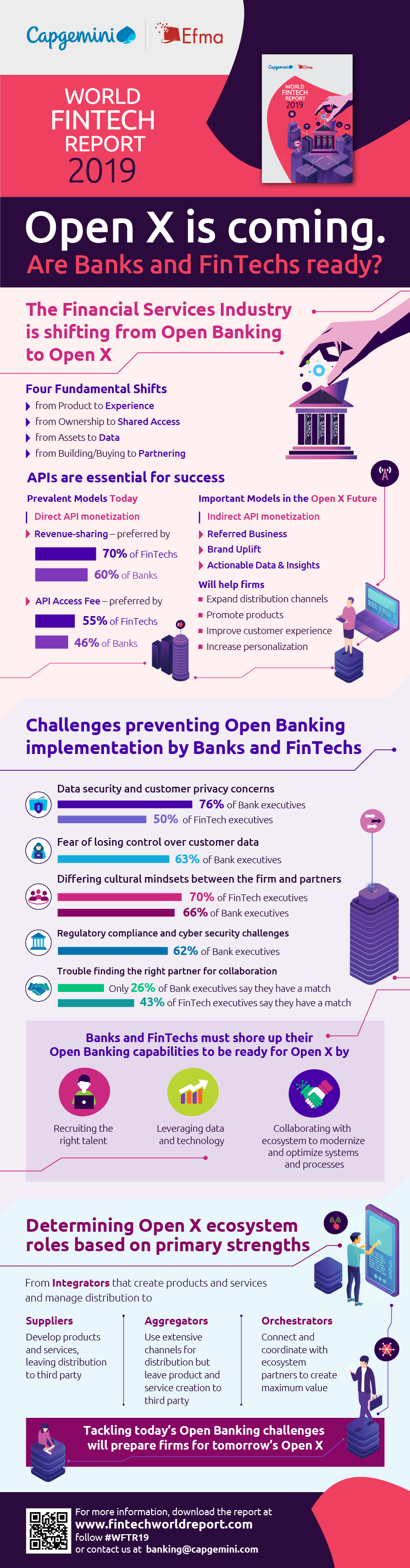
Capgemini's World FinTech Report 2019 Infographic

Key findings of the report include:

Open X will transform industry norms and assumptions

The advent of Open X is being driven by four fundamental shifts:

A move away from a focus on products to an emphasis on customer experience
The evolution of data as the critical asset
A shift from prioritizing ownership to facilitating shared access
Emphasis on partnering to innovate instead of buying or building new solutions
Open X will lead the financial services industry to a shared ecosystem or marketplace, in which the industry reintroduces the re-bundling of products and services, and both banks and FinTechs must re-evaluate their strategy for innovation and serving customers.

APIs will be critical Open X enablers

APIs, which allow third parties to access bank systems and data in a controlled environment, will be catalysts to creating the Open X marketplace. While customer data is already widely shared and leveraged in the industry, standardized APIs are not commonplace. Although requirements and regulations are complex, standardization will help to reduce fraud, improve interoperability, increase speed to market, and enhance scalability.

The WFTR 2019 also finds that industry players are looking at two potential monetization models for APIs – revenue-sharing (which 60% of banks and 70% of FinTechs think is feasible) and API access fees (supported by 46% of banks and 55% of FinTechs). However, only about a third of banking executives said they are currently well equipped to monetize APIs.

Privacy, security and collaboration concerns may slow progress

While banks and FinTechs said they understand the importance of collaboration, apprehension over privacy and security remain top of mind. When asked what concerns them about Open Banking, the vast majority of banks identified data security (76%), customer privacy (76%), and loss of control of customer data (63%). FinTechs were more optimistic about Open Banking, but 50% expressed fears over security and privacy, and 38% over the loss of control of customer data.

When asked about roadblocks to effective collaboration, 66% of banks and 70% of FinTechs pointed to a difference in the other’s organizational culture/mind-set, 52% of banks and 70% of FinTechs mentioned process barriers, and a lack of long-term vision and objectives were listed as gates by 54% of banks and 60% of FinTechs. Only 26% of bank executives and 43% of FinTech leaders said they had identified the right Open Banking collaboration partner. These responses suggest that many banks and FinTechs remain unprepared for Open Banking, let alone for the increased demands of data sharing and integration that Open X will bring.

Open X participants must choose strategic, specialty-based roles

Within the Open X marketplace, banks will need to enhance their integrated (traditional) model first and then focus on areas of specialized strength. The WFTR 2019 identifies three strategic roles expected to evolve as a part of Open X:

Suppliers will develop products and services;
Aggregators will amass products and services from the marketplace and distribute them through internal channels, holding onto customer relationships;
Orchestrators will act as market connectors and coordinators, facilitating partner interactions.
According to the report, integrated firms2 are likely to struggle to match the time to market of an ecosystem of specialists and find it challenging to meet the unique demands from customers. Within the Open X marketplace, many incumbents may not be best positioned to compete as an Orchestrator and their strengths may lead them to other roles. No matter what role they assume in Open X, however, they must recruit the right talent, leverage data and technology, and collaborate with FinTechs to first ensure better internal capabilities for competitive delivery of relevant services in the current Open Banking scenario.

“Open Banking has long been regarded as transformational for financial services, but this report shows it is just one part of a much bigger picture,” said Anirban Bose, CEO of Capgemini’s Financial Services and Member of the Group Executive Board. “The industry is on the verge of a more comprehensive evolution, where there is opportunity to leapfrog into an integrated marketplace that we are calling Open X. In Open X, there will be seamless sharing of data, and ecosystem partners will be able to collaborate in a far more comprehensive way. Our research suggests that banks and FinTechs need to prepare themselves for a more radical change than many previously anticipated.”

“The findings of the report could not be clearer: collaboration will be the foundation of the future of financial services,” said Vincent Bastid, Secretary General of Efma. “In the era of Open X, ecosystem players will have to work together more effectively than they have previously. Only by embracing collaboration and new, specialist roles can both banks and FinTechs thrive and best serve their customers. It’s clear that many barriers to collaboration still exist, and there is an urgent need to overcome them for collective benefit.”

Report methodology

The World FinTech Report 2019 is based on a global survey encompassing responses from 116 traditional financial services firms and 40 FinTech firms including banking and lending, payments and transfers, and investment management. Questions sought to yield perspectives from both FinTech and traditional financial services firms— exploring the emergence of Open Banking in the financial services industry. It sheds light on the impact the new ecosystem will have on all the stakeholders, the challenges and concerns that firms will face, and the emergence of new businesses and monetization models in this space.

About Capgemini

A global leader in consulting, technology services and digital transformation, Capgemini is at the forefront of innovation to address the entire breadth of clients’ opportunities in the evolving world of cloud, digital and platforms. Building on its strong 50-year heritage and deep industry-specific expertise, Capgemini enables organizations to realize their business ambitions through an array of services from strategy to operations. Capgemini is driven by the conviction that the business value of technology comes from and through people. It is a multicultural company of over 200,000 team members in more than 40 countries. The Group reported 2018 global revenues of EUR 13.2 billion.

Visit us at www.capgemini.com. People matter, results count

About Efma

A global non-profit organization, established in 1971 by banks and insurance companies, Efma facilitates networking between decision-makers. It provides quality insights to help banks and insurance companies make the right decisions to foster innovation and drive their transformation. Over 3,300 brands in 130 countries are Efma members.

Headquarters in Paris. Offices in London, Brussels, Andorra, Stockholm, Bratislava, Dubai, Milan, Montreal, Istanbul, Beijing, Tokyo and Singapore. Learn more www.efma.com.

____________________________________________
1 Application programming interface (API) refers to a set of functions and procedures that a player opens to the external world to allow the creation of applications that access the features or data of an operating system, application, or other service.
2 Integrated firms refer to the firms that perform all the functions on their own without collaborating or leveraging other firms in the ecosystem. Many of the banks in the current ecosystem are integrated firms as they build, produce, and distribute their own products for all business lines (without leveraging FinTechs or other players in the ecosystem)

Filed Under: Briefing

Footer

Recent Posts

  • TSMC Q2 2026: A 15% Capex Hike Outweighs a Record Profit Beat
  • Micron’s $500 Million GlobalWafers Financing Points to a New Bottleneck
  • META Compute, Samsung, SK Hynix: Where AI Infrastructure Investors Think the Margin Actually Sits
  • AMD Acquired MEXT to Make Flash Behave Like DRAM. It Eases the Memory Crunch Without Threatening Micron or SanDisk.
  • The Memory Shortage Is an Existential Event for Small Electronics Makers, Not Just a Margin Hit
  • The Manic Phase Is Real. The Crash Date Is Not.
  • Oracle’s $95 Billion Capex Guide Meets a 6.5% PPI: Today’s Session Is the Test for Nvidia, AMD, and the AI Chip Trade
  • PPI May 2026: Producer Prices Surge 1.1% as Iran War Energy Shock Hits the Pipeline, Goods Inflation Sets a Record
  • June 22 Is the Date That Changes Everything for MRVL Shareholders
  • SpaceX (SPCX) IPO: Why Facebook’s 2012 Debut Is the Warning Label on the Largest IPO in History

Media Partners

  • Market Analysis
  • k4i.com
  • Market Research Media
The AI Iron Curtain: Xi’s Shanghai Keynote Is the Fulton Speech of the AI Cold War
Enterprise Money Is Leaving Old School IBM for AI Infrastructure Companies
Why EU Tech Is Falling Behind the US: A Structural Diagnosis, Not a Cultural One
The HyperLight Threat to Coherent and Lumentum Ends Where Indium Phosphide Begins
SpaceX IPO (SPCX): A $1.75 Trillion Valuation Built on Selling 4% of the Company to People Who Watch Rocket Launches
What a Trillion-Dollar Cloudflare Actually Requires
The Repricing and the Drain: How SpaceX, OpenAI, and Anthropic Rewire the Index
Quantum Computing Equities: Market Segment Memo
Quantum Computing Stocks Face Violent Selloff the Moment Markets Reopen Tuesday
The $2.6 Trillion Signal: What Gartner’s AI Spending Forecast Actually Tells You
Micron's 8% Drop on the CXMT IPO and HBM Export Rumor Is Positioning, Not a Supply Shock
Marvell (MRVL) and 6G: A Shrinking RAN Franchise Bets on the Nvidia Alliance
Trump Country Tariffs Struck Down by Supreme Court, Replaced by Temporary 10% Section 122 Surcharge
Samsung Denies Bloomberg Report of US ADR Listing Talks After SK Hynix Raises $26.5 Billion on Nasdaq
The Memory Cycle Will Not End With Saturation: HBM4, CXMT, and What Actually Breaks DRAM Pricing
UMC and SILITH Hit Silicon Photonics Mass Production: What It Means for Marvell
Lutnick Presses Samsung and SK Hynix to Build US Memory Fabs: What It Means for the Memory Cycle
Memory Semiconductors July 2026: The 89% Ceiling on Earnings Revisions
KOSPI Falls Despite Samsung's Record Quarter: A Sell-The-News Story
Market Roundup: Broadcom-Apple Extends, Meta's Compute Dilemma, And 0DTE Options Hit A Record
Getty Images Kills the $3.7 Billion Shutterstock Merger Rather Than Sell the Editorial Business the UK Demanded
Fox’s $22B Roku Deal: 4.6x Sales, Paid in 1.5x Stock
Tuesday Open: AI Earnings Engine Holds the Line as Iran Overhang Fades to Noise
China’s U.S. Treasury Holdings: The Great Repositioning (2021–2025)
Infographic: Why the 2025 CIPA Data Proves the APS-C Renaissance is Real
How WiFi Changed Media
Canva Acquires Simtheory and Ortto to Build End-to-End Work Platform
Netflix Price Hikes, The Economics of Dominance in a Saturated Streaming Market
America’s Brands Keep Winning Even as America Itself Slips
Kioxia’s Storage Gambit: Flash Steps Into the AI Memory Hierarchy

Media Partners

  • 3V.org
  • Referently.com
  • Media Presser
Inside the Cobot Boom: What a Yaskawa Trade Show Floor Reveals About Industrial Automation
10Beauty Raises $23.5M to Scale Robotic Manicures Beyond Boston
SOX -5.3%: The Case for a Semiconductor Recovery Next Week
Wall Street Closes H1 2026 Near Records as the Jobs Print Moves to Thursday and AI-Memory Cracks
Marvell (MRVL) Joins the S&P 500 on June 22. The Inclusion Trade Is Already Spent
Barilla Opens Good Food Makers 2026 Applications Through July 10
The Future Is Here, Just Not Equally Distributed
Westin Grand Central, Three Days in May: The 21st Needham Technology, Media & Consumer Conference
Berkshire Hathaway's Annual Meeting Without Warren Buffett
Canelo vs. Benavidez: The Fight Boxing Spent Years Avoiding
Sponsored Post
About
Contact
FINRA Ends the Pattern Day Trader Rule: What the New Intraday Margin Standards Mean
Wi-Fi 8 (IEEE 802.11bn): Everything Known So Far About the Ultra High Reliability Standard
The VIX 'Buy When It Spikes' Rule: What the Data Actually Shows
The Forward Deployed Engineer Is the AI Industry's Admission That Models Don't Ship Themselves
The CNN Fear & Greed Index: How to Read It, What It Measures, and Where It Fails
VIX Explained: What the Fear Gauge Actually Measures, How to Read It, and Why It Mean-Reverts
Bitdefender 2026 Global Scam Intelligence Report: One in Seven Consumers Victimized, Finance Fraud Dominates Every Channel
Integral Privacy Technologies Raises $25M to Build the Privacy Layer for AI's Real-World Data Push
SanDisk's June 22 Share Swap Is a Non-Event for SNDK
MarketAnalysis.com Publishes Comprehensive Quantum Computing Equity Memo Covering IONQ, QBTS, RGTI, QUBT, XNDU, INFQ
What Is an Analyst Call
China Has Shed $357 Billion in U.S. Treasuries Since 2021
Foreign Debt Holdings Are a Trade Deficit Problem, Not Just a Fiscal One
Foreign Holdings of U.S. Federal Debt Reached $9.2 Trillion in 2025
Japan Holds $1.185 Trillion in U.S. Debt and the Number Tells an Incomplete Story
NAB 2026: Las Vegas and the End of the Broadcast Era
Private Investors Now Dominate Foreign Holdings of U.S. Treasury Debt

Copyright © 2026 Analysis.org

Media Partners: Technologies · Market Analysis · Market Research · Referently · Photography

We use cookies on our website to give you the most relevant experience by remembering your preferences and repeat visits. By clicking “Accept”, you consent to the use of ALL the cookies.
Do not sell my personal information.
Cookie SettingsAccept
Manage consent

Privacy Overview

This website uses cookies to improve your experience while you navigate through the website. Out of these, the cookies that are categorized as necessary are stored on your browser as they are essential for the working of basic functionalities of the website. We also use third-party cookies that help us analyze and understand how you use this website. These cookies will be stored in your browser only with your consent. You also have the option to opt-out of these cookies. But opting out of some of these cookies may affect your browsing experience.
Necessary
Always Enabled
Necessary cookies are absolutely essential for the website to function properly. These cookies ensure basic functionalities and security features of the website, anonymously.
CookieDurationDescription
cookielawinfo-checkbox-analytics11 monthsThis cookie is set by GDPR Cookie Consent plugin. The cookie is used to store the user consent for the cookies in the category "Analytics".
cookielawinfo-checkbox-functional11 monthsThe cookie is set by GDPR cookie consent to record the user consent for the cookies in the category "Functional".
cookielawinfo-checkbox-necessary11 monthsThis cookie is set by GDPR Cookie Consent plugin. The cookies is used to store the user consent for the cookies in the category "Necessary".
cookielawinfo-checkbox-others11 monthsThis cookie is set by GDPR Cookie Consent plugin. The cookie is used to store the user consent for the cookies in the category "Other.
cookielawinfo-checkbox-performance11 monthsThis cookie is set by GDPR Cookie Consent plugin. The cookie is used to store the user consent for the cookies in the category "Performance".
viewed_cookie_policy11 monthsThe cookie is set by the GDPR Cookie Consent plugin and is used to store whether or not user has consented to the use of cookies. It does not store any personal data.
Functional
Functional cookies help to perform certain functionalities like sharing the content of the website on social media platforms, collect feedbacks, and other third-party features.
Performance
Performance cookies are used to understand and analyze the key performance indexes of the website which helps in delivering a better user experience for the visitors.
Analytics
Analytical cookies are used to understand how visitors interact with the website. These cookies help provide information on metrics the number of visitors, bounce rate, traffic source, etc.
Advertisement
Advertisement cookies are used to provide visitors with relevant ads and marketing campaigns. These cookies track visitors across websites and collect information to provide customized ads.
Others
Other uncategorized cookies are those that are being analyzed and have not been classified into a category as yet.
SAVE & ACCEPT