• Skip to main content
  • Skip to secondary menu
  • Skip to footer

Analysis.org

Intelligence Analysis in Market Context

  • Sponsored Post
  • Market Research Reports
    • Technology Analysis
  • About
  • Contact

Tariffs, Populism, and Political Risk: Could the End of De Minimis Bring Down a Government?

August 29, 2025 By Analysis.org

The termination of the de minimis exemption is not just a dry matter of customs law—it carries profound political consequences. For years, millions of Americans, particularly lower-income households, relied on duty-free small packages to buy cheap goods from abroad, whether fast fashion from Shein, household trinkets from Temu, or small electronic gadgets shipped directly from Asia. Ending that exemption overnight has created a sharp, visible price shock that lands on consumers in the most politically sensitive way: at the checkout counter. Unlike abstract tariffs on steel or semiconductors, which only gradually work their way through supply chains, this policy makes people feel the pain immediately when they order a $20 item and suddenly face an $80 flat duty at delivery. It is precisely this visibility that makes the measure a political lightning rod.

Governments that implement sudden consumer-facing tariffs risk being perceived as both economically reckless and politically out of touch. The policy is being sold as a defense of U.S. manufacturing, a way to protect jobs, and a barrier against illicit goods such as fentanyl. But for ordinary citizens, the narrative is far simpler: “my package just got taxed at four times its value.” This kind of shock can feed into an anti-incumbent mood, especially if opposition parties frame it as a regressive tax on working families while wealthier households barely notice. The flat-rate duty mechanism—$80 to $200 per package—magnifies the sense of unfairness, because it penalizes low-cost items disproportionately. A $20 toy from China now costs $120, but a $1,500 luxury bag only rises to $1,580. That asymmetry is politically explosive.

Logistically, the turmoil adds to the impression of poor governance. Postal services worldwide are halting shipments, backlogs are forming at customs, and consumers are left confused as to who is collecting duties. These images of chaos—packages piling up, international sellers pulling out of the U.S. market, small online businesses complaining of ruin—can quickly morph into a symbol of failed economic management. If a government insists on permanence (“dead on arrival” for reinstating exemptions) while chaos persists, the opposition has a ready-made narrative of arrogance and insensitivity.
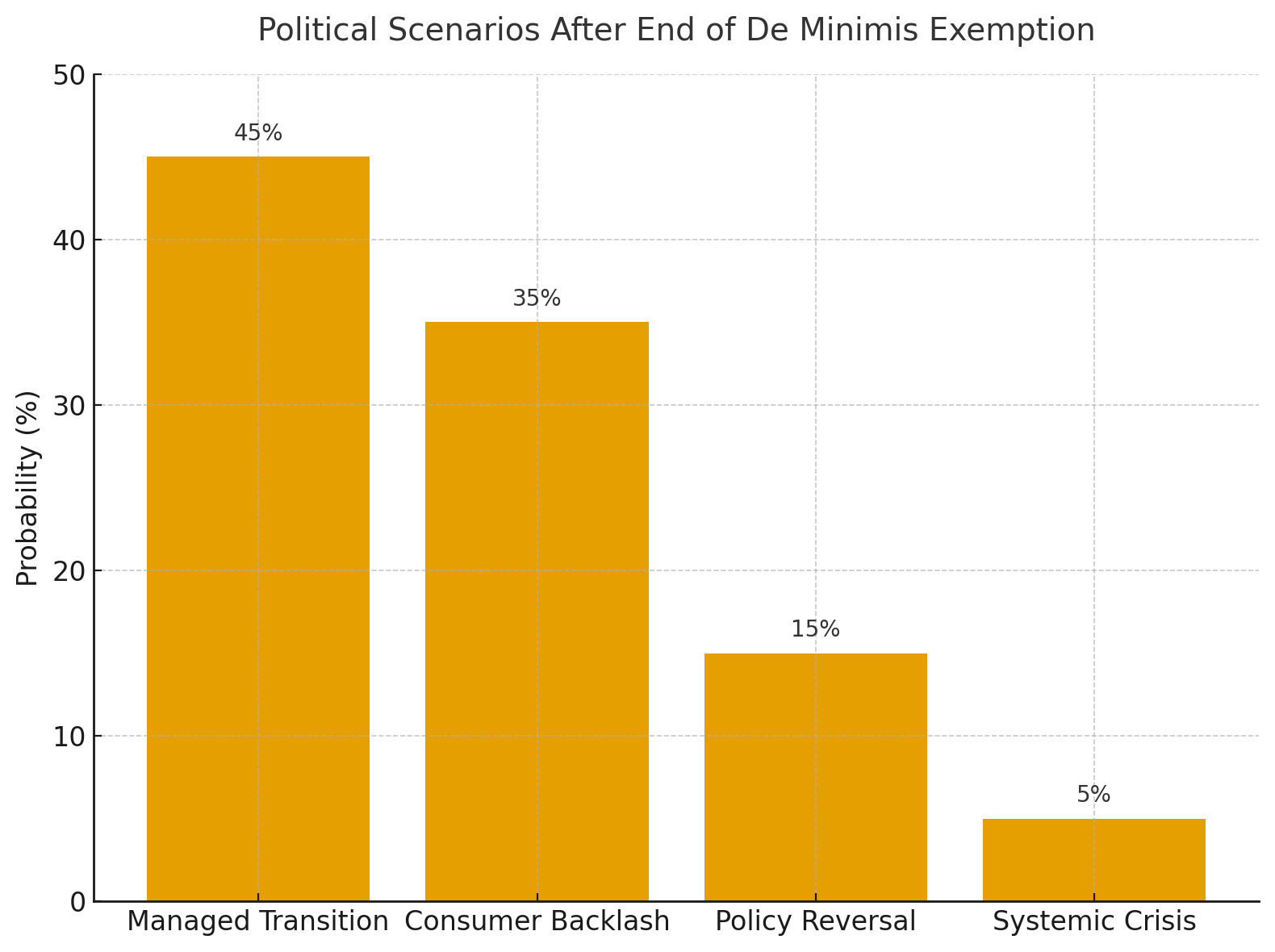
Political Scenarios After End of De Minimis Exemption

The chart illustrates that while a managed transition remains the most likely outcome, the risk of consumer backlash is significant. A smaller but non-trivial chance exists for policy reversal, and in a worst-case scenario, the chaos could indeed snowball into a systemic political crisis that threatens the survival of the government.

Whether this policy could “topple” a government depends on timing and context. If implemented in a period of already high inflation, voter discontent, and political polarization, it may become the proverbial straw that breaks the camel’s back. Tariff shocks have historically reshaped elections: think of the Smoot-Hawley Tariff Act of 1930, which became synonymous with deepening the Great Depression and cost Republicans dearly. A modern replay—where millions of small-ticket consumers feel directly attacked—could galvanize populist backlash, particularly if it aligns with broader discontent over living costs, inequality, and elite detachment.

Political Scenarios After End of De Minimis Exemption

Scenario Description Probability (rough) Political Consequence
Managed Transition Government smooths logistics, offers rebates or carve-outs, anger fades over 6–12 months. 45% Policy remains; approval ratings dip but government endures.
Consumer Backlash Visible price shocks (“$20 item becomes $120”) spark media outrage and grassroots anger. 35% High risk of defeat in next election or collapse of a fragile coalition.
Policy Reversal Leadership introduces carve-outs (e.g., essentials) or partially retreats to targeted tariffs. 15% Embarrassment and credibility hit, but governing coalition survives.
Systemic Political Crisis Logistics chaos persists; protests and non-compliance grow; policy becomes symbol of incompetence. 5% Resignations or early elections; government topples.

Filed Under: Briefing

Footer

Recent Posts

  • Micron Crosses $700 Billion as AI Memory Shortage Rewrites the Valuation Floor
  • The Trade Desk Q1 2026: Revenue Growth Holds, But the Margin Story Is Compressing
  • Dropbox Q1 2026: Revenue Stabilization, Margin Compression, and the Debt-Funded Buyback Question
  • Cloudflare Grows 34%, Cuts 1,100 Jobs, and Watches Its Stock Decline 19% in After-Hours Trading
  • AI Didn’t Create the Layoffs. It Just Made Them Speakable.
  • AMD +20% Premarket — Sector Repricing, Not a One-Stock Event
  • GameStop Bids $56 Billion for eBay
  • Apple Delivers a Power Quarter as Growth Reaccelerates Across the Board
  • PayPal’s Reset Moment Feels Less Like a Shuffle and More Like a Bet on Focus
  • Reading the PEG Ratio Across Nvidia, Broadcom, and AMD

Media Partners

  • Market Analysis
  • k4i.com
  • Market Research Media
Why Memory Prices Won’t Come Down
The Bill Comes Due
The Software-Defined Camera Won. The Open OS Did Not.
Cars Are Computers Now, and Most Carmakers Aren’t
Gartner: Global IT Spending to Hit $6.31 Trillion in 2026, Driven by AI Infrastructure
The SDK Generator Benchmarks: Infrastructure vs. Convenience
Infographic: We Are Likely in the Early Stages of Another Productivity Boom
Infographic: Establishing the National Multimodal Freight Network
Global WiFi Market: Size, Segmentation, Trends, and Forecast to 2030
Synera’s $40M Series B: What the Press Release Isn’t Saying
Google Trends as an OSINT Tool
New York City's Tax Cliff: What Mamdani's Agenda Gets Wrong
Reform Is No Longer an Insurgency. It's a Realignment.
3,375 Dead in Iran. The IC's Visibility Into What Remains Is the Harder Question.
A Tanker Was Hit in the Strait. Attribution in a Contested Waterway Is Not Simple.
China's Role in the Iran Truce Is Confirmed. What That Means for U.S. Intelligence Is Unresolved.
Gabbard's IC Modernization Push: Largest-Ever Cybersecurity Investment Completes Year One
Gas at $4.45 and Rising. Energy Economics as an Intelligence Signal in the Iran Standoff.
House Intelligence Committee Moves on Counterintelligence Reform as Atkinson Transcripts Are Released
IARPA Launches Five AI Programs Under Accelerated Framework: ARCADE, COSMIC, DECIPHER, LOCUS, MOVES
China’s U.S. Treasury Holdings: The Great Repositioning (2021–2025)
Infographic: Why the 2025 CIPA Data Proves the APS-C Renaissance is Real
How WiFi Changed Media
Canva Acquires Simtheory and Ortto to Build End-to-End Work Platform
Netflix Price Hikes, The Economics of Dominance in a Saturated Streaming Market
America’s Brands Keep Winning Even as America Itself Slips
Kioxia’s Storage Gambit: Flash Steps Into the AI Memory Hierarchy
Mamdani Strangling New York
The Rise of Faceless Creators: Picsart Launches Persona and Storyline for AI Character-Driven Content
Apple TV Arrives on The Roku Channel, Expanding the Streaming Platform Wars

Media Partners

  • 3V.org
  • Referently.com
  • Media Presser
The Future Is Here, Just Not Equally Distributed
Westin Grand Central, Three Days in May: The 21st Needham Technology, Media & Consumer Conference
Berkshire Hathaway's Annual Meeting Without Warren Buffett
Canelo vs. Benavidez: The Fight Boxing Spent Years Avoiding
Elon Musk's Nvidia Comments and the Market Attention Problem
Generation Z in the Labor Market: What the Data Actually Shows
Harley-Davidson's 2024–2026 Recall and What It Signals
Joel Embiid and the Injury Question That Never Goes Away
Kentucky Derby 2026: What the Result Tells You
Miami Grand Prix 2026 and the American F1 Calculus
Sponsored Post
About
Contact
Where Is Joshua Van From?
Event Marketing Glossary: Conference and Tradeshow Terms Defined
Market Research Glossary: Key Terms and Definitions
Photography Terms: A Working Glossary
ShinyHunters
What Is Optical Connectivity, and Why Does AI Infrastructure Depend on It?
60 GHz WiGig Is Not Dead: Here Is Where It Actually Makes Sense
What Is an Analyst Call
China Has Shed $357 Billion in U.S. Treasuries Since 2021
Foreign Debt Holdings Are a Trade Deficit Problem, Not Just a Fiscal One
Foreign Holdings of U.S. Federal Debt Reached $9.2 Trillion in 2025
Japan Holds $1.185 Trillion in U.S. Debt and the Number Tells an Incomplete Story
NAB 2026: Las Vegas and the End of the Broadcast Era
Private Investors Now Dominate Foreign Holdings of U.S. Treasury Debt
The United States Paid $282 Billion in Interest to Foreign Debt Holders in 2025
Why Belgium Holds More U.S. Debt Than Saudi Arabia, and What That Actually Means
Biometric Technologies and Congress: Recent Legislation and Open Questions

Copyright © 2026 Analysis.org

Media Partners: Technologies · Market Analysis · Market Research · Referently · Photography

We use cookies on our website to give you the most relevant experience by remembering your preferences and repeat visits. By clicking “Accept”, you consent to the use of ALL the cookies.
Do not sell my personal information.
Cookie SettingsAccept
Manage consent

Privacy Overview

This website uses cookies to improve your experience while you navigate through the website. Out of these, the cookies that are categorized as necessary are stored on your browser as they are essential for the working of basic functionalities of the website. We also use third-party cookies that help us analyze and understand how you use this website. These cookies will be stored in your browser only with your consent. You also have the option to opt-out of these cookies. But opting out of some of these cookies may affect your browsing experience.
Necessary
Always Enabled
Necessary cookies are absolutely essential for the website to function properly. These cookies ensure basic functionalities and security features of the website, anonymously.
CookieDurationDescription
cookielawinfo-checkbox-analytics11 monthsThis cookie is set by GDPR Cookie Consent plugin. The cookie is used to store the user consent for the cookies in the category "Analytics".
cookielawinfo-checkbox-functional11 monthsThe cookie is set by GDPR cookie consent to record the user consent for the cookies in the category "Functional".
cookielawinfo-checkbox-necessary11 monthsThis cookie is set by GDPR Cookie Consent plugin. The cookies is used to store the user consent for the cookies in the category "Necessary".
cookielawinfo-checkbox-others11 monthsThis cookie is set by GDPR Cookie Consent plugin. The cookie is used to store the user consent for the cookies in the category "Other.
cookielawinfo-checkbox-performance11 monthsThis cookie is set by GDPR Cookie Consent plugin. The cookie is used to store the user consent for the cookies in the category "Performance".
viewed_cookie_policy11 monthsThe cookie is set by the GDPR Cookie Consent plugin and is used to store whether or not user has consented to the use of cookies. It does not store any personal data.
Functional
Functional cookies help to perform certain functionalities like sharing the content of the website on social media platforms, collect feedbacks, and other third-party features.
Performance
Performance cookies are used to understand and analyze the key performance indexes of the website which helps in delivering a better user experience for the visitors.
Analytics
Analytical cookies are used to understand how visitors interact with the website. These cookies help provide information on metrics the number of visitors, bounce rate, traffic source, etc.
Advertisement
Advertisement cookies are used to provide visitors with relevant ads and marketing campaigns. These cookies track visitors across websites and collect information to provide customized ads.
Others
Other uncategorized cookies are those that are being analyzed and have not been classified into a category as yet.
SAVE & ACCEPT