• Skip to main content
  • Skip to secondary menu
  • Skip to footer

Analysis.org

Intelligence Analysis in Market Context

  • Sponsored Post
  • Market Research Reports
    • Technology Analysis
  • About
  • Contact

Companies Can Flip the Odds of Success in Digital Transformations from 30% to 80%

October 29, 2020 By Analysis.org

New BCG Research Identifies Six Factors That Determine the Success Rate of Digital Transformations; All Six Must Be Applied to Win

Most digital transformations fail, but making sure that six critical success factors are in place can reverse the odds of success from 30% to 80%, according to a new report from Boston Consulting Group (BCG), Flipping the Odds of Digital Transformation Success, released today.

BCG’s research found that only 30% of transformations met or exceeded their target value and resulted in sustainable change. Another 44% created some value but did not meet their targets and resulted in only limited long-term change. A final 26% created limited value (less than 50% of the target) and produced no sustainable change. (See Exhibit 1 from the report below.)

From a comparative point of view, successful transformations created, on average, 66% more value, improved corporate capabilities by 82%, and met 120% more of their targets on time than transformations that created only limited value. Compared with those that created some value, winners created 29% more value, improved capabilities by 20%, and met 32% more targets on time.
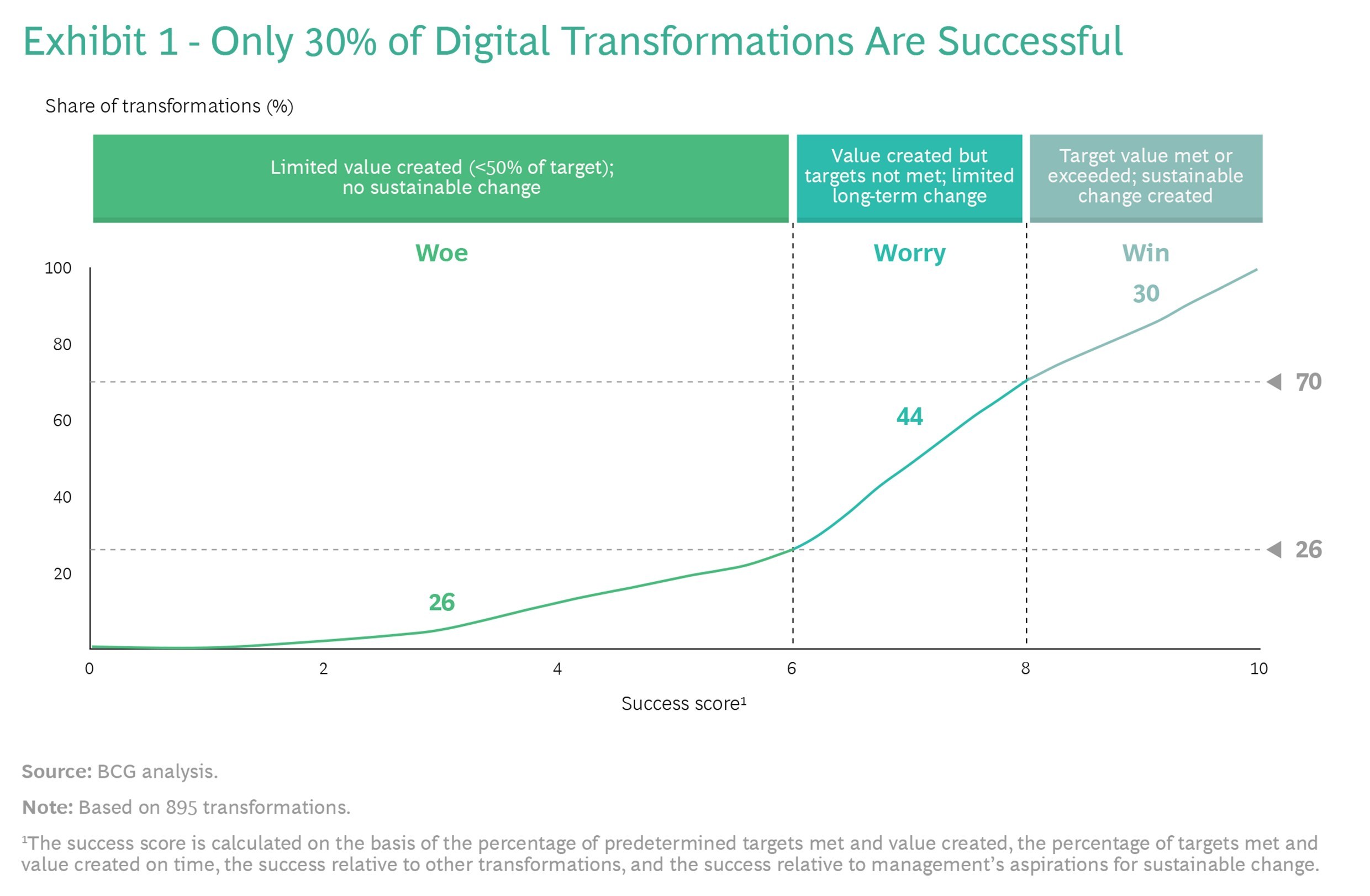
Flipping the Odds of Digital Transformation Success, Boston Consulting Group Digital Transformation Infographic

The results are important because BCG research also shows that more than 80% of companies plan to accelerate their companies’ digital transformations, largely in response to the COVID-19 pandemic. Digital leaders achieve earnings growth that is 1.8 times higher than digital laggards—and more than double the growth in total enterprise value.

“In the short term, digital technologies and ways of working offer productivity improvements and better customer experiences,” says Patrick Forth, a BCG managing director and senior partner and a coauthor of the report. “In the medium term, digital opens up new growth opportunities and business model innovation. Successful transformations also set companies up for sustained success; they won’t have to digitally transform again as they master continuous innovation.”

The six success factors are:

An Integrated Strategy with Clear Transformation Goals. The strategy describes the why, the what, and the how, which are tied to specific, quantified business outcomes.
Leadership Commitment from CEO Through Middle Management. The company has high leadership engagement and alignment, including often-overlooked middle-management ownership and accountability.
Deploying High-Caliber Talent. Management identifies and frees up the most capable resources to drive the transformation program.
An Agile Governance Mindset That Drives Broader Adoption. Leaders address roadblocks quickly, adapt to changing contexts, and drive cross-functional, mission-oriented, “fail-fast-learn” behavioral change into the wider organization. They deal with individual challenges without losing sight of the broader goals.
Effective Monitoring of Progress Toward Defined Outcomes. The company establishes clear metrics and targets around processes and outcomes, with sufficient data availability and quality.
Business-Led Modular Technology and Data Platform. The company puts in place a fit-for-purpose, modern technology architecture driven by business needs to enable secure, scalable performance, rapid change deployment, and seamless ecosystem integration.
When tackling these six factors, companies must satisfy two conditions. First, management needs to make sure that each of the six is adequately addressed in their planning, preparation, and execution. Most companies put effort into this, but the majority of these organizations do not address each factor sufficiently. Second, it is crucial to address all six factors. Companies that adequately addressed only three or four failed. Of all of the possible combinations examined, none had the same impact on success as these six.

BCG’s research involved both internal and external data sets: internal data from BCG’s experience working with 70 leading companies worldwide on their digital transformations over the past several years and external data from the responses of 825 senior executives in a detailed survey about their transformation experience.

“The positive and material impact of the six success factors can be seen across all types of digital transformation, geographies, and industries,” says Tom Reichert, the chairman of global practices at BCG, the global leader of DigitalBCG, and a report coauthor. “That said, it is neither practical nor desirable to delay transformation in pursuit of perfection. Instead, winners will be aware of shortcomings and will put an action plan in place to address each as they proceed.”

In the survey, executives were asked to assess their transformations on a scale of 1 to 10. Success was defined to include the percentage of predetermined targets met and value achieved, the percentage of targets and value met on time, the success relative to other transformations, and the success relative to management’s aspirations for sustainable change. The research tested more than 35 factors that reflect commitment, strategy and approach, governance, financial and people resourcing, and technology enablers.

A copy of the report can be downloaded here.

To arrange an interview with one of the authors, please contact Eric Gregoire
at +1 617 850 3783 or [email protected].

About Boston Consulting Group
Boston Consulting Group partners with leaders in business and society to tackle their most important challenges and capture their greatest opportunities. BCG was the pioneer in business strategy when it was founded in 1963. Today, we help clients with total transformation—inspiring complex change, enabling organizations to grow, building competitive advantage, and driving bottom-line impact.

To succeed, organizations must blend digital and human capabilities. Our diverse, global teams bring deep industry and functional expertise and a range of perspectives to spark change. BCG delivers solutions through leading-edge management consulting along with technology and design, corporate and digital ventures—and business purpose. We work in a uniquely collaborative model across the firm and throughout all levels of the client organization, generating results that allow our clients to thrive.

SOURCE Boston Consulting Group (BCG)
www.bcg.com

Filed Under: Briefing

Footer

Recent Posts

  • Yuan Gains Ground, But the Dollar Still Dominates
  • MongoDB Expands Irish Operations with €74 Million Investment in AI and Engineering Growth
  • ServiceNow Q1 2026: The AI Control Tower Thesis Is Holding
  • Adobe’s $25 Billion Buyback Is a Bet on Itself
  • Adobe, Unloved and Increasingly Alienated by Users and Investors
  • Cloudflare Shares Are Poised for a Jump — Here Is Why the Setup Is Compelling
  • Nvidia, AMD, and Broadcom Are Rising Again — and the Market Is Telling You Something
  • OPEC+ in a Blocked Market: Why 200,000 Barrels Don’t Matter
  • Oil Shock 2026: Hormuz Risk Premium Rewrites the Curve
  • Why ServiceNow, Salesforce, and Atlassian Fell on the Anthropic Mythos Announcement

Media Partners

  • Market Analysis
  • k4i.com
  • Market Research Media
Gartner: Global IT Spending to Hit $6.31 Trillion in 2026, Driven by AI Infrastructure
The SDK Generator Benchmarks: Infrastructure vs. Convenience
Infographic: We Are Likely in the Early Stages of Another Productivity Boom
Infographic: Establishing the National Multimodal Freight Network
Global WiFi Market: Size, Segmentation, Trends, and Forecast to 2030
Synera’s $40M Series B: What the Press Release Isn’t Saying
Amazon’s Globalstar Acquisition Is a Spectrum War Dressed as a Satellite Deal
The End of Manual Audits: Why AI-Native Accounting Is Not Optional Anymore
Raspberry Pi’s Earnings Beat Signals a Shift From Hobbyist Hardware to Embedded Infrastructure
Betting the Backbone: A Multi-Year Positioning on AMD, Broadcom, and Nvidia
Belt and Road Is Still Central: China's Global Supply Chain Strategy
China Wants to Write the Rules for AI — Globally
China's 15th Five-Year Plan: What It Is and Why It Matters
China's Economic Problem: Strong Supply, Weak Demand
China's Financial Pilot Programs: Hainan, Shanghai, Shenzhen
China's Push for Science and Technology Self-Reliance
Chips and Code: China's Semiconductor and Software Agenda in the 15th FYP
Military-Civil Fusion in China's 15th Five-Year Plan
SkillBit Powers Global Cyber Arena at ICC 2026 in Australia
The Sectors China Is Betting On: 15th FYP Industrial Priorities
Infographic: Why the 2025 CIPA Data Proves the APS-C Renaissance is Real
How WiFi Changed Media
Canva Acquires Simtheory and Ortto to Build End-to-End Work Platform
Netflix Price Hikes, The Economics of Dominance in a Saturated Streaming Market
America’s Brands Keep Winning Even as America Itself Slips
Kioxia’s Storage Gambit: Flash Steps Into the AI Memory Hierarchy
Mamdani Strangling New York
The Rise of Faceless Creators: Picsart Launches Persona and Storyline for AI Character-Driven Content
Apple TV Arrives on The Roku Channel, Expanding the Streaming Platform Wars
Why Attraction-Grabbing Stations Win at Tech Events

Media Partners

  • 3V.org
  • Referently.com
  • Media Presser
Adobe Summit Investor Session, April 21, 2026, Las Vegas
Tempus AI Introduces Active Follow-Up Model to Keep Oncology Care Aligned with Rapidly Evolving Guidelines
Birch Coffee Keeps Growing in NYC with Square Powering the Back End
What Actually Holds Europe Together
Retention Over Turnover: Clasp’s $20M Bet on Fixing Healthcare Hiring
Doctronic Secures $40 Million Series B as Autonomous AI Medicine Moves Into Real Clinical Practice
Halter Lands $220 Million to Scale Virtual Fencing Worldwide
How Phone Cameras Changed Everyday Memory
Perfect Corp. Brings AI Shopping Agents to the Frontline of Retail at Shoptalk 2026
Tensions Drive Energy and Markets
60 GHz WiGig Is Not Dead: Here Is Where It Actually Makes Sense
802.11r, 802.11k, 802.11v: The Three Protocols That Make WiFi Roaming Seamless
HaLow (802.11ah): The Sub-1 GHz WiFi Standard Built for IoT That Nobody Talks About
How Enterprise WiFi Authentication Actually Works: 802.1X and RADIUS Explained
How to Read Your WiFi Signal Strength: What dBm Numbers Actually Mean
Mesh WiFi vs Access Points: Which Architecture Is Right for Your Home
Multi-Link Operation Explained: How WiFi 7 Uses Multiple Bands Simultaneously
Reconfigurable Intelligent Surfaces: The Coming Upgrade to Indoor WiFi Coverage
The Comprehensive WiFi Guide
The Hidden Math Behind WiFi Speed Claims: What 9.6 Gbps Really Means
China Has Shed $357 Billion in U.S. Treasuries Since 2021
Foreign Debt Holdings Are a Trade Deficit Problem, Not Just a Fiscal One
Foreign Holdings of U.S. Federal Debt Reached $9.2 Trillion in 2025
Japan Holds $1.185 Trillion in U.S. Debt and the Number Tells an Incomplete Story
Private Investors Now Dominate Foreign Holdings of U.S. Treasury Debt
The United States Paid $282 Billion in Interest to Foreign Debt Holders in 2025
Why Belgium Holds More U.S. Debt Than Saudi Arabia, and What That Actually Means
Biometric Technologies and Congress: Recent Legislation and Open Questions
Biometric Technologies and Global Security: An Overview
How Biometric Technologies Are Being Used Today

Copyright © 2017 Analysis.org

Technologies, Market Analysis & Market Research Reports, Photography

We use cookies on our website to give you the most relevant experience by remembering your preferences and repeat visits. By clicking “Accept”, you consent to the use of ALL the cookies.
Do not sell my personal information.
Cookie SettingsAccept
Manage consent

Privacy Overview

This website uses cookies to improve your experience while you navigate through the website. Out of these, the cookies that are categorized as necessary are stored on your browser as they are essential for the working of basic functionalities of the website. We also use third-party cookies that help us analyze and understand how you use this website. These cookies will be stored in your browser only with your consent. You also have the option to opt-out of these cookies. But opting out of some of these cookies may affect your browsing experience.
Necessary
Always Enabled
Necessary cookies are absolutely essential for the website to function properly. These cookies ensure basic functionalities and security features of the website, anonymously.
CookieDurationDescription
cookielawinfo-checkbox-analytics11 monthsThis cookie is set by GDPR Cookie Consent plugin. The cookie is used to store the user consent for the cookies in the category "Analytics".
cookielawinfo-checkbox-functional11 monthsThe cookie is set by GDPR cookie consent to record the user consent for the cookies in the category "Functional".
cookielawinfo-checkbox-necessary11 monthsThis cookie is set by GDPR Cookie Consent plugin. The cookies is used to store the user consent for the cookies in the category "Necessary".
cookielawinfo-checkbox-others11 monthsThis cookie is set by GDPR Cookie Consent plugin. The cookie is used to store the user consent for the cookies in the category "Other.
cookielawinfo-checkbox-performance11 monthsThis cookie is set by GDPR Cookie Consent plugin. The cookie is used to store the user consent for the cookies in the category "Performance".
viewed_cookie_policy11 monthsThe cookie is set by the GDPR Cookie Consent plugin and is used to store whether or not user has consented to the use of cookies. It does not store any personal data.
Functional
Functional cookies help to perform certain functionalities like sharing the content of the website on social media platforms, collect feedbacks, and other third-party features.
Performance
Performance cookies are used to understand and analyze the key performance indexes of the website which helps in delivering a better user experience for the visitors.
Analytics
Analytical cookies are used to understand how visitors interact with the website. These cookies help provide information on metrics the number of visitors, bounce rate, traffic source, etc.
Advertisement
Advertisement cookies are used to provide visitors with relevant ads and marketing campaigns. These cookies track visitors across websites and collect information to provide customized ads.
Others
Other uncategorized cookies are those that are being analyzed and have not been classified into a category as yet.
SAVE & ACCEPT